
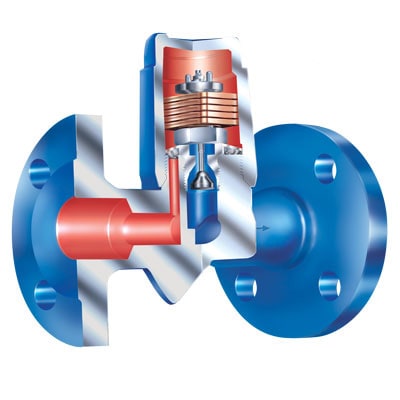
Match discharge behaviour to the duty
A steam trap removes condensate while limiting loss of live steam. Heat exchangers, steam-main drainage and tracing have different requirements. Establish the need for immediate drainage, air removal and response to varying loads. Copying an existing connection diameter does not ensure equivalent capacity or behaviour.
Three different operating principles
Float traps respond to condensate level. Thermostatic traps respond to temperature and discharge with a model-dependent degree of subcooling. Thermodynamic disc traps cycle through flow and pressure effects. These principles are a starting point; verify capacity, minimum differential pressure and orientation in the model catalogue.
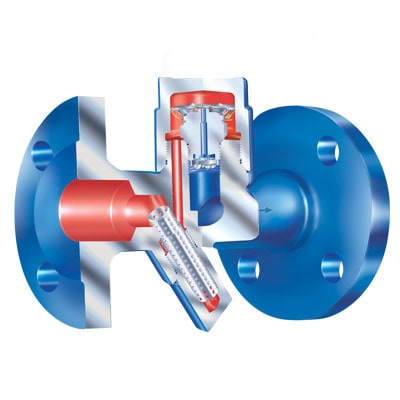
Check the most demanding condition
Warm-up load can differ from normal duty, while rising return pressure reduces available differential pressure. Check inlet and outlet pressures together with hot-condensate capacity. Consider freezing, contamination and maintenance access. Interpret temperature, ultrasonic measurement and process behaviour together during periodic inspections.
Let’s select the right product.
Consider nominal size, pressure class, fluid, temperature, connection and actuation together. Refer to the technical catalogue for suitable materials and operating limits.