
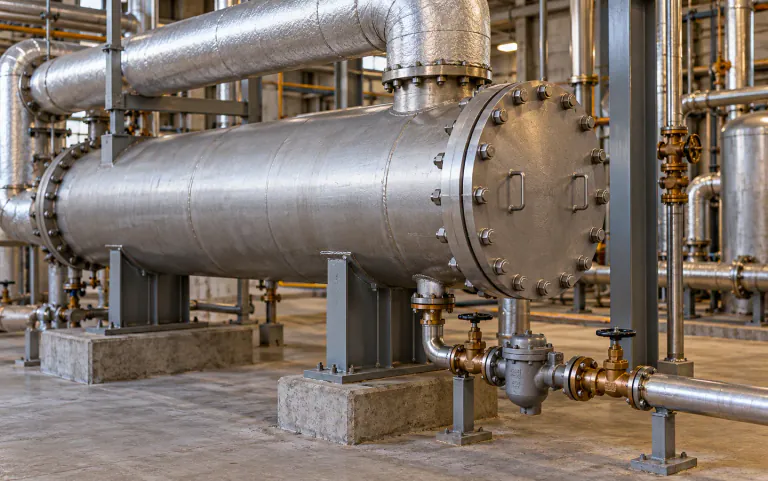
A blocked trap is not the only possible cause
Condensate flow can fall or stop when exchanger pressure reaches or falls below total backpressure; this is called stall. Before deciding to fit a larger trap, map the pressure relationship on both sides. The following is an illustrative engineering scenario, not the result of an installed plant or a capacity statement for a particular brand. Actual selection requires measured process conditions.
Illustrative scenario: two operating points
For this first calculation, assume zero elevation difference and pipe loss. At full load, let the exchanger outlet be 2.0 bar(g) and the condensate return 1.2 bar(g): the available difference is 0.8 bar. If exchanger pressure falls to 0.6 bar(g) at low load, the difference becomes −0.6 bar. The g denotes gauge pressure. Under these assumptions, there is no driving pressure for passive forward drainage; increasing connection size does not create pressure.
Extend the calculation to the real plant
Place actual outlet and return-connection elevations and measured pressures on the same sketch. Do not assume the return pressure is constant; record periods when other users are operating. Give startup, full load and low load separate rows. This exposes boundary conditions instead of hiding them behind one nominal operating pressure. Separate measured values from design assumptions in the worksheet to make the calculation easier to review.
Assess the remedy as a system
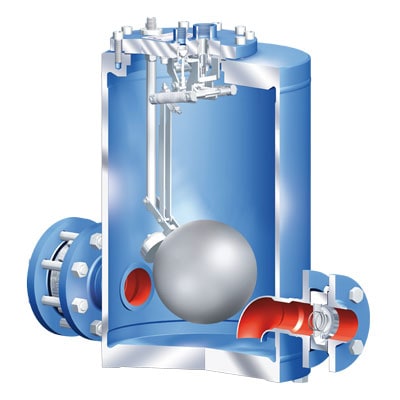
ARI-CONLIFT is an example of a mechanical condensate pump driven by steam or pressurised gas. The product name alone does not establish correct capacity or installation layout. Ask the proposal to state its design load, backpressure, equipment limits and required connection schematic. In the same technical discussion, clarify how the arrangement will be isolated for maintenance and how the process will operate during that period.
A practical enquiry and acceptance check
Include the exchanger load range, steam and condensate pressure records, piping sketch, available installation height and control logic in the enquiry. Define stable low-load operation as an acceptance objective alongside full-capacity heating. If the problem occurs at a particular load, agree in advance how that condition will be reproduced. Changes to pressure equipment require an appropriate engineering design and a qualified installation team.
Let’s select the right product.
Consider nominal size, pressure class, fluid, temperature, connection and actuation together. Refer to the technical catalogue for suitable materials and operating limits.